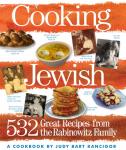
BUY COOKING JEWISH by clicking here now.


Rosh Hashanah
Rosh Hashanah/Break-the-Fast/Sukkot recipes
Here are some other ideas for your holiday feast.
SOUPS
Fragrant Carrot Soup with Indian Spices
BREAD
Merlot-Braised Short Ribs with Cipollini Onions
Chicken in Persian Pomegranate Walnut Sauce
Dja’jeh b’Ah’sal (Chicken With Prunes and Honey)
Jaffa Orange-Ginger Chicken with Baharat
Moroccan Spicy Apricot Lamb Shanks
SIDE DISHES
Persimmon, Pomegranate, and Pecan Salad
Libyan Couscous With Chickpeas, Squash, Zucchini and Eggplant
Baked Apples with Shallots and Herbs
Roasted Eggplant and Pomegranate Seed Salad
CLICK HERE FOR MORE HOLIDAY RECIPES
Apple Sweetened Rosh Hashanah
My story in the Orange County Register celebrates apples with recipes from "The Silver Palate Cookbook: 25th Anniversary Edition" by Julee Rosso and Sheila Lukins, "A Passion for Baking" by Marcy Goldman and "The Santa Monica Farmers' Market Cookbook" by Amelia Saltsman.
You'll find recipes for Cinnamony Baked Apples, Rougemont Apple Pastry Cake, Ellen's Apple Tart, and Baked Applesauce.
From my family to yours, wishing you all a Happy New Year filled with sweet surprises.
The Orange County Register, Thursday, October 25, 2008
by Judy Bart Kancigor
Stroll through the farmers' market, and you feel fall approaching. As we say goodbye to summer's heat, those achingly sweet, soft, dribble-down-your-chin melons, peaches and plums give way to fall's bounty of apples: cool and crisp as an autumn's day. Read the whole story.
Rosh Hashanah memories
When I was growing up, my large, boisterous family would gather in my grandparents’ tiny apartment in Mom and me Belle Harbor, New York, for the festive Rosh Hashanah meal. Papa Harry, who had emigrated from Russia in 1906 as a carpenter, would extend the dining table with boards reaching practically to the walls. The arrival of the aunties with their foil-covered dishes signaled the beginning of the holiday feast, a menu that seldom varied:
For the forshpeis (appetizer) Aunt Estelle’s homemade, lovingly shaped gefilte fish served with Uncle Lou’s horseradish, hand-grated on the back porch to keep out the fumes;
 Aunt Irene
Aunt Irene’s golden chicken soup and ethereal matzo balls, followed by Mama Hinda’s roast chicken and brisket with oven-browned potatoes and Aunt Sally’s tsimmes (sweet carrot stew).
The centerpiece of the table was Mama Hinda’s grand spiral challah, round for Rosh Hashanah, the Jewish New Year, a symbol of the endless cycle of life. Only for this holiday would she add raisins, a sweet embellishment to enjoy a sweet New Year.
Sweet notes echoed from the beginning of the meal, as all assembled dipped apples in honey, to the dessert platters wedged onto Mama’s groaning sideboard: Aunt Irene’s dark, dense honey cake, Aunt Estelle’s mile-high sponge cake, Aunt Hilda’s chocolate chip
Rosh Hashanah's comin' and the livin' is easy
Orange County, CA caterer, Blueberry Hill
This week's recipe: BLUEBERRY HILL’S MANGO CHUTNEY BRISKET
I can tell Rosh Hashanah is approaching, because I’m already getting phone calls from my family and friends, my mother’s friends, even strangers!
“Can I make the brisket ahead and freeze it?” “Can I freeze the kugel?” “What should I do about my burnt honey cake?” (Yes and yes to the first two and “Um, do you have a dog?” to the third.)
Jewish cooks the world over are shopping and chopping, searing and sautéing – so many dishes, so little time.
In bygone days our foremothers, stay-at-home moms before that term ever became popular, had little distractions from the task at hand: putting a holiday feast on the table for their large extended families.
Today’s cooks squeeze the job in between work, carpools, meetings, etc. – all while trying to recreate those labor-intensive recipes their grandmothers slaved over. For what is a holiday if not the gathering of families connecting to their roots and traditions?
Now Orange County boasts its own kosher caterer, Blueberry Hill, that can provide a full dinner or even help out with a dish or two so you can enjoy your guests as you celebrate together.
(“The perception always was that kosher food is awful,” said Beverly Scheftz, who with her son Trevor owns and operates Blueberry Hill, “but it doesn’t have to be that way, and it’s definitely not that way.”
Posted in Submitted by Judy on Fri, 09/07/2012 - 7:03am.
Honey sweet, honey bitter
Up to my eyeballs with Rosh Hashanah preparations – lamb shanks roasting, honey orange sponge cake cooling upside down over a soda bottle, chicken soup simmering, apples all over my counter waiting to be sliced – I hear the doorbell. Slightly annoyed at the interruption, I open the door to find the UPS man delivering my eagerly-awaited copy of “Sweet Myrtle and Bitter Honey: The Mediterranean Flavors of Sardinia” (Rizzoli International) by restaurateur Efisio Farris with Jim Eber.
A cookbook with honey taking center stage arrives erev Rosh Hashanah. How beshert (destined) is that?
Sardinians flavor not only their desserts, but also their savory dishes with many varieties of local honey: miele millefiori (thousand flower honey), eucalyptus, chestnut, and the afodelo, acacia, and cardo flowers.
But two are truly unique in flavor – abbamele, a honey and pollen reduction they drizzle over ice cream, cheese, fresh fruit...even salads, and miele amaro or bitter honey, made from the flowers of the strawberry trees – a staple in every Sardinian kitchen – whose flavor Farris describes as “a deep yet fleeting sweetness, followed by an appealingly bitter aftertaste.” (Bitter honey as well as
Breaking the fast the Ginter way
 Nonni LizzieA Yom Kippur recipe story. Now, there’s an oxymoron if I ever heard one.
Yom Kippur, the holiest day in the Jewish calendar, is a day of repentance, prayer, forgiveness…and fasting. So this would be a really short story if not for the fact that all good fasts must come to an end, and indeed they do in the lovely tradition called Break-the-Fast.
Dede and Ed Ginter have been hosting a Break-the-Fast at their Fullerton home for the past 35 years. “We have mostly the same people every year,” said Dede, “and we stagger the meal, because different temples get out at different hours."
“But we do have some turnover from year to year,” Ed pointed out. “Whenever we hear of somebody with no place to go, we invite them. Sometimes they are students, or my granddaughter will have a friend who likes to eat, so we say, ‘Bring her along!’”
After a day of praying and fasting, the meal, as in most homes, is dairy. “We have lots of fruit, lox and bagels, a kugel (noodle pudding), poached salmon, a variety of sweets, and my kids’ favorite, cheese blintz soufflé,” said Dede. ”It’s an old recipe and really nice, because you can prepare it before you go to temple. Then when you get home, you bring it to room temperature, and 40 minutes before your guests arrive, you just pop it in the oven, and it puffs up beautifully.”
Dede makes two kugels to please all. “My grandkids don’t like raisins, so I make one with and one
Something old and something new for the holiday
By JUDY BART KANCIGOR
The Orange County Register
September 17, 2009
RECIPES:
Chicken Casserole with Dried Fruit on a Bed of Couscous
Apple, Cinnamon and Walnut Cake
An old saying goes, ask two Jews a question and you'll get three opinions.
Controversy, controversy. In politics you expect it, but it's true even in
cooking.
Take the much maligned, yet oh, so beloved Jewish appetizer that graces
every holiday table from the weekly celebration of the Sabbath to Rosh Hashana,
the Jewish New Year: Gefilte fish.
In the Middle Ages Jewish mystics viewed fish as signaling the coming of the
Messiah. No wonder it is served for every holiday. Fish was expensive in
Europe, and the recipe was developed as an economical way to stretch it so that
every family member could get a taste.
The word gefilte is actually German for "stuffed." The original
recipe called for seasoned, ground boned fish mixed with eggs and fillers, such
as vegetables and crumbs, which was then stuffed back into the fish skin and
cooked. Over the centuries, the skin was eliminated, with cooks shaping the
mixture into balls or patties and poaching them.
But wherein lies the controversy? Do we open a jar or make it ourselves…or
"doctor" the jarred variety? Do we like it sweet or peppery? With
some guests adoring it and others repelled at the very sight, do we even serve
it at all?
Moroccan Spicy Apricot Lamb Shanks
From Cooking Jewish: 532 Great Recipes from the Rabinowitz Family (Workman) by Judy Bart Kancigor
Order on amazon
While brisket and roast chicken are standard fare for our holiday dinners, our Sephardic mishpuchah dines on dishes like this tender, spicy lamb, which was adapted from Molly O'Neill's take on a recipe by superchef Alain Ducasse.
When I interviewed Wolfgang Puck about his seders at Spago, he told me that if he had been born Jewish, he would have liked to have been born Sephardic because of the cuisine. I know what he means! I love the pungent Moroccan spice mixture and usually make extra to save for flavoring other dishes. The wine is an untraditional addition and would never be used in a Moroccan kitchen.
Interestingly, cookbook author Joyce Goldstein told me that Jews in Arab countries, despite the fact that they do not share their neighbors' prohibition against drinking wine, traditionally do not use it in cooking either. Purists may substitute additional chicken broth for the wine.
4 lamb shanks (about 1 pound each), visible fat removed
Kosher (coarse) salt to taste
2 tablespoons olive oil
2 medium-size onions, chopped
2 to 3 tablespoons coarsely chopped garlic
1 cup dry red wine
1 3/4 cups homemade chicken stock or 1 can (14 1/2 ounces) low-sodium chicken broth
Moroccan Spice Mix (recipe follows)
1 cup dried apricots
Black pepper to taste
Posted in Submitted by Judy on Sun, 09/23/2007 - 1:26pm.
Rosh Hashanah Apple Torte
from "The Foods of Israel Today" by Joan Nathan
as seen in The Orange County Register, 9-14-01
2 cups unbleached all-purpose flour
1/2 teaspoon baking powder
1/4 teaspoons salt
1 large egg
3/4 cup (1 1/2 sticks) unsalted butter or margarine, cut into small pieces
1 cup sugar, divided use
Grated zest (colored peel) of 1 lemon
6 medium (about 3 pounds) Granny Smith or other flavorful apples, peeled and cored
1/2 teaspoon ground cinnamon
Preliminaries: Fifteen minutes before baking, preheat oven to 450 degrees.
1. Put flour, baking powder, salt, egg, butter or margarine, 3/4 cup sugar and zest in food processor fitted with metal blade. Process until soft dough forms. Remove, roll in flour and wrap in plastic wrap; refrigerate 20 minutes.
2. Meanwhile, coarsely grate apples in food processor fitted with grating blade or use large holes on hand grater. Toss with remaining 1/4 cup sugar and set aside in colander to drain 30 minutes. Add cinnamon and toss.
3. Take 2/3 of dough and with floured fingertips, press it lightly into bottom and 2 inches up sides of 9-inch springform pan. Spoon apple mixture evenly into dough shell.
4. Roll out remaining dough on lightly floured surface into 9-inch circle about 1/8-inch thick. Place on top of apples, crimping edges of dough together to seal them. Make a few holes in top with tines of fork. Bake on middle rack of preheated oven 15 minutes. Reduce heat to 350 degrees and bake 30 additional minutes or until golden brown.
Yield: 8-10 servings
Jaffa Orange-Ginger Chicken With Baharat
from "The Foods of Israel Today" by Joan Nathan
as seen in The Orange County Register, 9-14-01
Salt to taste
1 tablespoon baharat, or to taste; see cook's notes
1 tablespoon ground ginger, or to taste
8 boneless, skinless chicken breasts
4 tablespoons olive oil
1/2 cup white wine
1/2 cup orange liqueur
1 cup chicken broth
4 tablespoons honey
1 1/2 cups orange juice
1 tablespoon grated fresh ginger
2 tablespoons grated orange zest
2 tablespoons finely chopped crystallized ginger
2 oranges, peeled and sectioned
Cook's notes: Joan Nathan says baharat is a spice mixture that varies from cook to cook, but often includes paprika, (ground) chili, cumin, coriander, cinnamon, black pepper, allspice, nutmeg, cardamom, cloves and salt. "If you can't find the mixture at a Middle Eastern market, choose from you favorite of these spices instead, making sure you include pepper," Nathan writes.
If you prefer thicker sauce, after chicken has cooked, remove chicken from sauce and increase heat to high; boil until reduced to 3/4 to 1 cup. Return chicken to sauce and complete step 5.
Posted in Submitted by Judy on Sun, 09/23/2007 - 7:12am.
