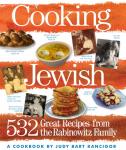
BUY COOKING JEWISH by clicking here now.

Judy's Articles
Gnocchi for Passover!
The
Orange County Register/Fullerton News Tribune
April 3, 2014
Kosher gnocchi means you don't have to pass on
kitchen delights during Passover
Making holiday memories
Canadian Jewish News April 2008
by Judy Bart Kancigor
Happy New Year! No, I haven't forgotten how to read a calendar (and can still find my way home and hardly ever drool on my sweater.) For Jews preparing for Passover (beginning Saturday evening, April 19) the spring holiday is another way to mark the beginning of the Jewish year.
While Rosh Hashanah, literally translated “head of the year,” is the spiritual new year, Nissan, the month of Passover, is sometimes considered the first month, because it denotes the beginning of our liberation from slavery and the exodus of our ancestors from Egypt.
And just in time for Passover, the culinary crescendo of the year for Jewish cooks, comes the long-awaited “Passover by Design” (Artscroll) from Susie Fishbein, with over 130 Passover-adjusted recipes, plus 30 brand-new ones, and the leap-off-the-page, glorious photos and clever décor ideas we have come to expect from this wildly popular author of the Kosher by Design series.
“Passover by Design” contains many of the recipes we love in Fishbein’s previous books, conveniently reformulated for the holiday, plus some enticing additions, including Teriyaki Chicken Satés, Beef Roulade on Creamy Parsnips, Sliced Beef with Shiitakes and Cherry Brandy Sauce, Steamed Sea Bass in Savoy Cabbage, Cranberry Chicken, Quinoa Timbales with Grapefruit Vinaigrette and Chocolate Chip Cheesecake.
Celebrating Passover with her large, lively family brings back vivid memories, said Fishbein by phone from her home in New Jersey. “It was just a frenzy, people of all ages celebrating together. The women tended to live into their nineties. That was always so beautiful, so many generations sitting at the table. There were so many people, so much to do. It was just a really happy, busy time.”
Passover - spring cleaning on steroids!
My grandmother, Mama Hinda, was a burier. No, not an undertaker. Okay, spell it berye. Yiddish for major-domo cleaner extraordinaire. As in white glove test above the door frame. As in you could eat off the floor. As in using the basement oven to keep the upstairs kitchen clean.
And if Mama was thorough during the year, before Passover she was fanatic, whipped to a joyous frenzy to ready the house for the holiday and remove all chometz (bread or any food containing leaven)…every last crumb.
Weeks before she would scrub, scour, scald, polish and shine. As the holiday approached, her Passover dishes – one set for milchig (dairy) and one set for fleishig (meat) – would be brought from the basement and washed. My Aunt Sally remembered, when she was a child in the 1920’s, Mama soaking glasses for three days and burying silverware outside with hot coals for use during the holiday. No closet, no shelf, no corner evaded her purification ritual.
On the night before Passover, Papa Harry and the children would search the already scoured home for any remaining crumbs of chometz, which would be swept up with a feather and burned. (So stringent is the prohibition that Jews are forbidden not only to consume, but even to possess such things as bread, noodles, yeast and other leavening agents, or anything made with flour during the holiday.)
Downstairs in the cold cellar, the earthen crock of rossl (fermented beets) Mama had started weeks before stood ready to infuse her borscht (beet soup), and eggs by the crate awaited her practiced hand to whisk them into ethereal citrus sponge cakes and irresistible chocolate nut tortes.
Rising to the occasion
In a jam? Try this recipe for Hanukkah doughnuts.
The Orange County Register/Fullerton News Tribune
November 29, 2007
by Judy Bart Kancigor
An old joke goes like this: The Jewish holidays are always either early or late. They’re never on time!
Hanukkah sneaks up on us early this year. We’ll begin lighting candles at sundown on December 4, so prepare for an oil crisis, and I’m not referring to the price of gas. Who knew when Judah Maccabee's tiny flask of oil miraculously burned for eight days that for thousands of years Jewish families would celebrate by frying!
While Jews of Eastern Europe descent eat mountains of latkes (potato pancakes), the Hanukkah treat in Israel is sufganiyot (jelly doughnuts).
Fullerton's Pnina Shichor, a former teacher and proprietor of Bound to Travel on Euclid, has been making them for years.
"When my children were young," she recalled, "my cousin, Esther Schechter, and I would do Hanukkah at Rolling Hills Elementary School. We'd tell the story, sing songs, and teach the children to make sufganiyot."
When the Shichors were considering transferring daughter Nomi to Jewish day school, Nomi said, "But, Mom, if I go there, who will do Hanukkah for our class?"
Pnina's mother-in-law, Malka Suranyi, brought the recipe from Budapest where the family survived under Nazi rule. Luckily an uncle owned an exclusive men's clothing store, which the Nazis wanted, so they kept the workers alive. After the war the Communists took over, and Pnina's husband, David, professor of criminal justice at Cal State San Bernardino, was barely 16 when the Jewish Agency smuggled him and other children out of Hungary.
Chocolate for Hanukkah - why not?
While Jews of Eastern European descent celebrate Hanukkah with mountains of latkes, Sephardic Jews fry sufganiyot. But for everyone – and every holiday – there’s always…chocolate?
Yes, just about everyone’s favorite ingredient never goes out of season, claims award-winning author Alice Medrich, whose book “Chocolate Holidays: Unforgettable Desserts for Every Season” (Artisan) offers 50 luscious, decadent recipes to crown every holiday and celebration.
“I wanted to do a season-to-season book,” said Medrich by phone from her Berkley, California, home. “Other ingredients we like to cook with change with the seasons. The constant is chocolate.”
Jewish cooks know that Hanukkah is all about the oil. The symbolism goes back to ancient times, when Judah Maccabee and his tiny army defeated the Syrian-Greeks and recaptured Jerusalem. In attempting to rededicate the Temple, they found only enough oil to burn for one day. Miraculously it lasted eight days, and we've been celebrating with a frying frenzy ever since! But who says traditional potato latkes are the only fritter fit to fry?
“Chocolate Banana Blintzes are fried, and Hanukkah is a great excuse to serve them,” noted Medrich. “They are just so delicious, a fancy party dessert that’s easy to do.” Restraint, she said, is sometimes the secret ingredient. “A little burst of chocolate sauce in a hot crepe with bananas is more seductive than a chocolate blintz with chocolate filling,” she writes.
Another lesser-known Hanukkah tradition involves the story of Judith, a beautiful Jewish widow, who dined with the enemy general Holofernes. She plied him with cheese to make him thirsty for wine, and when he fell into a drunken stupor, she beheaded him with his own sword. Because her bravery is said to have inspired the Maccabees, some communities remember Judith by eating cheese during this holiday.
Tasty twist to healthy Thanksgiving eats
My friend Eileen Cohen knows her chocolate. In a blind taste test she can tell Tobleron from Godiva with her hands tied behind her back.
That’s why, when she raved about the chocolate mousse that nutrition expert and cookbook author Jennifer Flynn had served, I was intrigued. A healthy chocolate mousse? What was the secret? Would you believe avocado?
“Nobody believes me when I tell them they are eating avocado,” said Flynn, author of “The Super Food Generation: 14 Foods That Get You Glowing.”
“It’s amazing how well the other ingredients mask the flavor of this buttery fruit. The heart-healthy fat of the avocado is a perfect replacement for the dairy cream used in traditional mousse.”
Flynn became a vegetarian when a friend brought her an article about the conditions in slaughterhouses.
“I’m a really big animal lover, and I thought, I don’t want to be a part of this. My family didn’t think it would last, but I started paying attention to ingredients and noticing the hidden animal byproducts and ingredients you can’t even pronounce the names of.”
“The Super Food Generation” is not a diet book. “I wanted to get back to basics and promote healthy foods and ingredients rather than a particular diet,” she explained. “I want people be open-minded and not think so much about having to stick to a diet, but become more familiar with the healthy foods out there and adapt them to their own particular diet.”
Besides the avocado, pumpkin – along with carrots, sweet potatoes and its relatives in the squash family – is another of the 14 super foods that work “synergistically with the human body to unlock vitality, strengthen immunity and literally slow down the aging process,” Flynn writes.
Excuse me? Pumpkin Pie a health food? We’re talking about a healthy Thanksgiving feast now?
Posted in Submitted by Judy on Wed, 11/20/2013 - 7:07pm.
Apple Sweetened Rosh Hashanah
My story in the Orange County Register celebrates apples with recipes from "The Silver Palate Cookbook: 25th Anniversary Edition" by Julee Rosso and Sheila Lukins, "A Passion for Baking" by Marcy Goldman and "The Santa Monica Farmers' Market Cookbook" by Amelia Saltsman.
You'll find recipes for Cinnamony Baked Apples, Rougemont Apple Pastry Cake, Ellen's Apple Tart, and Baked Applesauce.
From my family to yours, wishing you all a Happy New Year filled with sweet surprises.
The Orange County Register, Thursday, October 25, 2008
by Judy Bart Kancigor
Stroll through the farmers' market, and you feel fall approaching. As we say goodbye to summer's heat, those achingly sweet, soft, dribble-down-your-chin melons, peaches and plums give way to fall's bounty of apples: cool and crisp as an autumn's day. Read the whole story.
Rosh Hashanah memories
When I was growing up, my large, boisterous family would gather in my grandparents’ tiny apartment in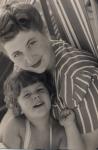 Mom and me Belle Harbor, New York, for the festive Rosh Hashanah meal. Papa Harry, who had emigrated from Russia in 1906 as a carpenter, would extend the dining table with boards reaching practically to the walls. The arrival of the aunties with their foil-covered dishes signaled the beginning of the holiday feast, a menu that seldom varied:
For the forshpeis (appetizer) Aunt Estelle’s homemade, lovingly shaped gefilte fish served with Uncle Lou’s horseradish, hand-grated on the back porch to keep out the fumes;
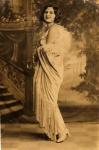 Aunt Irene
Aunt Irene’s golden chicken soup and ethereal matzo balls, followed by Mama Hinda’s roast chicken and brisket with oven-browned potatoes and Aunt Sally’s tsimmes (sweet carrot stew).
The centerpiece of the table was Mama Hinda’s grand spiral challah, round for Rosh Hashanah, the Jewish New Year, a symbol of the endless cycle of life. Only for this holiday would she add raisins, a sweet embellishment to enjoy a sweet New Year.
Sweet notes echoed from the beginning of the meal, as all assembled dipped apples in honey, to the dessert platters wedged onto Mama’s groaning sideboard: Aunt Irene’s dark, dense honey cake, Aunt Estelle’s mile-high sponge cake, Aunt Hilda’s chocolate chip
Rosh Hashanah's comin' and the livin' is easy
Orange County, CA caterer, Blueberry Hill
This week's recipe: BLUEBERRY HILL’S MANGO CHUTNEY BRISKET
I can tell Rosh Hashanah is approaching, because I’m already getting phone calls from my family and friends, my mother’s friends, even strangers!
“Can I make the brisket ahead and freeze it?” “Can I freeze the kugel?” “What should I do about my burnt honey cake?” (Yes and yes to the first two and “Um, do you have a dog?” to the third.)
Jewish cooks the world over are shopping and chopping, searing and sautéing – so many dishes, so little time.
In bygone days our foremothers, stay-at-home moms before that term ever became popular, had little distractions from the task at hand: putting a holiday feast on the table for their large extended families.
Today’s cooks squeeze the job in between work, carpools, meetings, etc. – all while trying to recreate those labor-intensive recipes their grandmothers slaved over. For what is a holiday if not the gathering of families connecting to their roots and traditions?
Now Orange County boasts its own kosher caterer, Blueberry Hill, that can provide a full dinner or even help out with a dish or two so you can enjoy your guests as you celebrate together.
(“The perception always was that kosher food is awful,” said Beverly Scheftz, who with her son Trevor owns and operates Blueberry Hill, “but it doesn’t have to be that way, and it’s definitely not that way.”
Posted in Submitted by Judy on Fri, 09/07/2012 - 7:03am.
Honey sweet, honey bitter
Up to my eyeballs with Rosh Hashanah preparations – lamb shanks roasting, honey orange sponge cake cooling upside down over a soda bottle, chicken soup simmering, apples all over my counter waiting to be sliced – I hear the doorbell. Slightly annoyed at the interruption, I open the door to find the UPS man delivering my eagerly-awaited copy of “Sweet Myrtle and Bitter Honey: The Mediterranean Flavors of Sardinia” (Rizzoli International) by restaurateur Efisio Farris with Jim Eber.
A cookbook with honey taking center stage arrives erev Rosh Hashanah. How beshert (destined) is that?
Sardinians flavor not only their desserts, but also their savory dishes with many varieties of local honey: miele millefiori (thousand flower honey), eucalyptus, chestnut, and the afodelo, acacia, and cardo flowers.
But two are truly unique in flavor – abbamele, a honey and pollen reduction they drizzle over ice cream, cheese, fresh fruit...even salads, and miele amaro or bitter honey, made from the flowers of the strawberry trees – a staple in every Sardinian kitchen – whose flavor Farris describes as “a deep yet fleeting sweetness, followed by an appealingly bitter aftertaste.” (Bitter honey as well as
